
Bucket Ball
Unity Developer
Microsoft Kinect v2 Windows
1
~6 months (Part-time alongside studies)
Bucket Ball (WonderTree)
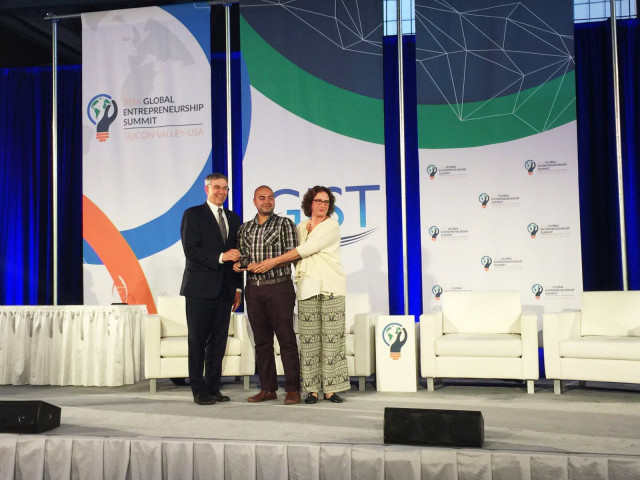
Bucket Ball is an interactive Kinect-based augmented reality game developed for WonderTree, designed to help children engage with motion-based gameplay using full-body and hand-tracking input. The project received 3rd Prize at the Global Innovation through Science and Technology (GIST) competition (Stanford, 2016) and was featured in Forbes for its innovation in assistive and educational interactive systems.
Overview
Bucket Ball (AR Motion Game – WonderTree):
Bucket Ball is a motion-based AR-style experience where players catch falling colored balls using either:
• A physical bucket in the real world
• A virtual bucket rendered on screen
Players must collect correct colored objects while avoiding red hazards, with scoring based on accuracy and reaction time.
The project focused heavily on real-time motion interaction, spatial alignment, and responsive XR gameplay systems.
🏆 Achievement:
• 3rd Prize – GIST Tech-I Startup Competition (Stanford University, 2016)
• Global Innovation through Science & Technology (GIST) Tech-I Startup Competition
📢 Media Recognition:
• Featured in Forbes – “Meet Pakistan's Wonder Boys Reimagining Special Education” (Sonya Rehman, 2016)
• Featured in regional news channels for innovation in assistive motion-based AR systems
Technical Break Down
Contributions
Core Gameplay Systems (Unity):
Designed and implemented core gameplay logic in Unity.
Built physics-based systems for spawning and falling objects.
Implemented scoring systems based on:
• Correct color collection
• Avoidance of hazard objects
Tuned spawn timing, randomness, and difficulty balancing to improve engagement, readability, and overall gameplay clarity.
Kinect Integration & Motion Tracking Systems:
Integrated Microsoft Kinect v2 for full-body and hand-tracking input.
Worked with Kinect’s multi-stream system, including depth, color, and skeleton data.
Implemented gesture recognition such as:
• Open hand / closed hand detection
• Hand cursor tracking for UI interaction and gameplay control
Handled spatial alignment between:
• 512×424 depth stream
• 1920×1080 RGB color stream
Implemented coordinate space conversion and matrix-based transformations to map skeletal joint positions from depth space into screen-space representation.
Ensured accurate alignment between physical movement and on-screen interaction despite differing sensor perspectives and resolutions.
-
Built a set of editor tools inside Unity to speed up production:
- Quick-play / instant launch tools for testing runs
- UI auto-anchor tools to speed up responsive UI setup
- Cleanup tools to reduce project clutter and memory usage
- These ended up saving a lot of time for both me and the team during production
Input System & UI Integration:
Built a custom input abstraction layer connecting Kinect gestures to Unity UI systems.
Enabled:
• Gesture-based menu navigation
• Hand cursor-driven selection and interaction
Ensured UI responsiveness under continuous motion-based input conditions.
Data Tracking & Backend Integration:
Collected gameplay performance metrics such as response time and interaction accuracy.
Structured and formatted gameplay session data on the client side for transmission.
Integrated REST API endpoints provided by the backend team to send gameplay data.
Enabled real-time reporting of player performance to a backend dashboard used by educators and medical professionals for progress tracking.
Performance Optimization & System Stability:
Optimized Unity performance for continuous sensor-driven gameplay.
Ensured stable frame pacing under real-time motion input conditions.
Conducted iterative testing for gesture accuracy and responsiveness.
Tuned system reliability across different physical play environments to maintain consistent user experience.
Key REsults
Technical Learnings & XR Systems Expertise:
• Early experience in motion-based XR interaction design
• Deep understanding of Kinect v2 multi-stream architecture
• Spatial mapping between depth and RGB coordinate spaces
• Translating noisy sensor input into stable gameplay systems
• Gesture recognition and custom input abstraction architecture
• Real-world telemetry design for educational applications
• Real-time performance optimization for XR systems under hardware constraints
Tech Stack
Technical Skills:
• Unity
• Microsoft Kinect v2
• C#
• Gesture Recognition Systems
• Coordinate Space Mapping (Depth ↔ RGB)
• Matrix-based Transformations
• REST APIs
• XR / AR Interaction Systems
• Real-time Optimization